Is 8 Hours of Sleep a Myth? What 65 Studies of 3,577 Good Sleepers Say Is Normal
Quick Summary
The 8-Hour Goal is a Myth for Most Older Adults: While younger adults average around 7.3 hours of sleep, this number steadily decreases. By age 65, a "normal" night's sleep is closer to 6.5 hours.
Night Wakings Are Normal and Increase Predictably: The amount of time spent awake during the night after you first fall asleep increases by about 10 minutes per decade after age 30. An hour of wakefulness spread across the night is typical for healthy seniors.
You Get Less Deep Sleep: Restorative deep sleep declines dramatically with age. A healthy 65-year-old may get only half the deep sleep of a 25-year-old, which is why sleep can feel less refreshing.
Sleep Quality Changes: Sleep becomes less efficient as we age. The percentage of time you spend actually asleep while in bed drops from over 90% in your 20s to closer to 80% in your later years.
We have all heard the advice: get a solid eight hours of sleep every night. It’s presented as the universal gold standard for good health. But as the years go by, many of us find that goal becoming harder and harder to reach. We wake up more frequently, we rise earlier, and we wonder if we’re failing at sleep.
This can create a cycle of anxiety about sleep. You worry about not getting your eight hours, and that worry itself can keep you awake. So, what if the goal itself is the problem? Is it realistic for a 65-year-old to expect to sleep like a 25-year-old?
To answer this, we can turn to the science. A landmark scientific review combined the results from 65 different studies, creating a massive dataset of 3,577 healthy people from age 5 to 102 (Ohayon et al., 2004). This research gives us the clearest, most evidence-based picture of what a “normal” night’s sleep actually looks like at different stages of life.
This article will translate the complex data from that study into understandable terms. Our goal is to provide you with realistic expectations for your sleep, helping you understand which changes are a typical part of aging and when you might want to seek help.
How Did Scientists Figure All This Out?
This information comes from a powerful type of study called a meta-analysis, a research method where scientists mathematically combine the results from many previous studies. This creates a single, highly reliable conclusion. Instead of relying on one small snapshot of the population, the researchers created a panoramic view of how sleep changes across a lifetime.
To do this, a team of sleep experts led by Dr. Maurice Ohayon conducted an exhaustive search for every relevant study published in peer-reviewed journals between 1960 and 2003. They started with over 4,000 reports and carefully filtered them down to the 65 studies that met their strict criteria.
Here’s what they looked for:
Objective Data: The studies had to use objective, scientific measurements of sleep, primarily polysomnography, a comprehensive in-laboratory test that records brain waves, eye movements, and muscle activity. This ensured the data was based on what was actually happening in the brain and body, not just on what people self-reported about their sleep. This is important, because people tend to over-estimate their sleep time when asked to self-report.
Healthy Participants: The studies had to focus on "nonclinical" participants—people who were not being treated for a specific sleep disorder or other major illness. This allowed the researchers to map the course of normal aging.
Numerical Results: Each study had to provide specific numbers (like the average total sleep time or the percentage of deep sleep) for different age groups.
By combining these 65 high-quality studies, the researchers created a massive and diverse dataset of 3,577 healthy individuals, with ages ranging from 5 to 102 years old. This large scale allowed them to identify subtle but significant trends that would be impossible to see in any single, smaller study. It's this comprehensive approach that makes their findings the gold standard for understanding how our sleep naturally changes over time.
What Exactly Did the Scientists Measure?
The primary tool used in these studies was polysomnography, the comprehensive test mentioned above. This allows scientists to precisely measure several key aspects of our sleep architecture, the technical term for how our sleep is structured throughout the night. Understanding these specific variables is the key to interpreting the data in the tables below.
Total Sleep Time (TST): The total number of minutes you are actually asleep.
Sleep Efficiency (SE): The percentage of time you spend asleep relative to the total time you spend in bed.
Wake After Sleep Onset (WASO): The total number of minutes you are awake during the night after you have fallen asleep for the first time.
Sleep Latency: How long it takes you to fall asleep after turning the lights out.
Sleep Stages: The different types of sleep you cycle through, including light sleep (Stages 1 and 2), deep sleep (Slow-Wave Sleep or SWS), and dream sleep (REM).
So, how do these numbers change as we grow up?
What Does Normal Sleep Look Like for Children and Teens?
This period is defined by major developmental changes in the brain, and the data shows that sleep structure changes significantly, while total sleep time is often shaped by social schedules rather than biology.
| Sleep Parameter | Typical Finding / Trend |
|---|---|
| Total Sleep Time (TST) | Highly dependent on environment. On non-school days, TST remains stable across this age range. On school days, it appears to decrease with age due to fixed morning start times. |
| Sleep Efficiency (SE) | High and stable. Healthy children and teens are typically very efficient sleepers, spending most of their time in bed asleep. |
| Time to Fall Asleep (Latency) | Short and stable. It does not typically increase during this period. |
| Deep Sleep (SWS) | High, but steadily decreasing. This is the most dramatic change. The percentage of restorative deep sleep is highest in childhood and declines consistently through the teenage years. |
| Light Sleep (Stage 2) | Steadily increasing. As the brain spends less time in deep sleep, it compensates by spending more time in Stage 2 sleep. |
| Dream Sleep (REM) | Modestly increasing. The percentage of REM sleep shows a small but significant increase from childhood to the end of adolescence. |
The most important finding here is that the common belief that teenagers naturally need less sleep is a myth. The data clearly shows their sleep is cut short by early school start times, not by a change in their biological needs (Ohayon et al., 2004).
But what happens once we enter adulthood and our sleep patterns mature?
What Does Peak Sleep Performance Look Like in Young Adulthood?
The sleep we get in our 20s and early 30s often serves as the benchmark for what we consider "perfect" sleep. The data shows that this is when sleep is most efficient and restorative.
| Sleep Parameter | Typical Average Value |
|---|---|
| Total Sleep Time (TST) | ~440 minutes (7 hours, 20 minutes). This is the average TST observed in laboratory settings for this age group. |
| Sleep Efficiency (SE) | ~92%. This indicates a very solid and unbroken night, with less than 8% of the time in bed spent awake. |
| Time Awake at Night (WASO) | ~25 minutes. After falling asleep, young adults spend very little time awake during the night. |
| Time to Fall Asleep (Latency) | ~18 minutes. |
| Deep Sleep (SWS) | ~20% of the night. A substantial portion of the night is spent in this physically restorative stage. |
| Light Sleep (Stages 1 & 2) | ~55% of the night. |
| Dream Sleep (REM) | ~23% of the night. |
This is the profile of a highly effective sleeper. As you can see, even at its peak, the average Total Sleep Time is closer to 7.5 hours than the often-cited 8. This is the baseline from which the gradual, normal changes of aging begin.
Why Does Sleep Start to Change in Middle Age?
For many, the 40s and 50s are when a shift in sleep becomes noticeable. It might be harder to fall back asleep after waking up, or the morning might arrive feeling a bit less refreshed. The data shows these feelings are grounded in real, measurable changes.
| Sleep Parameter | Typical Average Value |
|---|---|
| Total Sleep Time (TST) | ~415 minutes (6 hours, 55 minutes). The data shows a loss of about 10 minutes of sleep per decade. |
| Sleep Efficiency (SE) | ~89%. Sleep becomes slightly more fragmented, with the percentage of time spent awake in bed increasing. |
| Time Awake at Night (WASO) | ~45 minutes. The time spent awake during the night nearly doubles compared to young adulthood. |
| Time to Fall Asleep (Latency) | ~22 minutes. A small, often unnoticeable, increase from younger years. |
| Deep Sleep (SWS) | ~15% of the night. The decline in deep sleep becomes more significant, which can lead to feeling less refreshed. |
| Light Sleep (Stages 1 & 2) | ~60% of the night. |
| Dream Sleep (REM) | ~20% of the night. |
As the table shows, TST drops below the 7-hour mark, and the time spent awake at night (WASO) increases significantly. This is a normal evolution. Expecting the sleep of your 20s while in your 50s is like expecting to run as fast as you did two decades earlier; our bodies change.
What is a Realistic Sleep Expectation for Older Adults?
By the time we reach our mid-60s and beyond, our sleep has a new, established normal. It is typically lighter, shorter, and more fragmented than in our youth. Chasing an 8-hour, uninterrupted block of sleep at this age is not only unrealistic for most, but the pressure to do so can create unnecessary anxiety.
| Sleep Parameter | Typical Average Value |
|---|---|
| Total Sleep Time (TST) | ~395 minutes (6 hours, 35 minutes). Total sleep time continues its modest decline. |
| Sleep Efficiency (SE) | ~83%. It is typical for older adults to spend a larger portion of their time in bed awake. |
| Time Awake at Night (WASO) | ~65 minutes. Over an hour of the night may be spent awake after initially falling asleep. This is a normal, documented change. |
| Time to Fall Asleep (Latency) | ~25 minutes. |
| Deep Sleep (SWS) | ~11% of the night. Deep, restorative sleep now makes up a much smaller fraction of the night. |
| Light Sleep (Stages 1 & 2) | ~65% of the night. |
| Dream Sleep (REM) | ~19% of the night. |
The data is clear: a healthy 70-year-old sleeps very differently than a healthy 30-year-old. Total sleep time is shorter, and spending over an hour awake throughout the night is a standard part of the pattern. Accepting this as the new normal can be the first step toward reducing sleep-related stress.
What Do the Study's Graphs Show Us About Lifespan Sleep?
Beyond the tables, the study's graphs provide a powerful visual story of these changes.
In the graphs below, each dot represents the average result from one of the 65 studies, and the line running through them shows the overall trend across the lifespan.
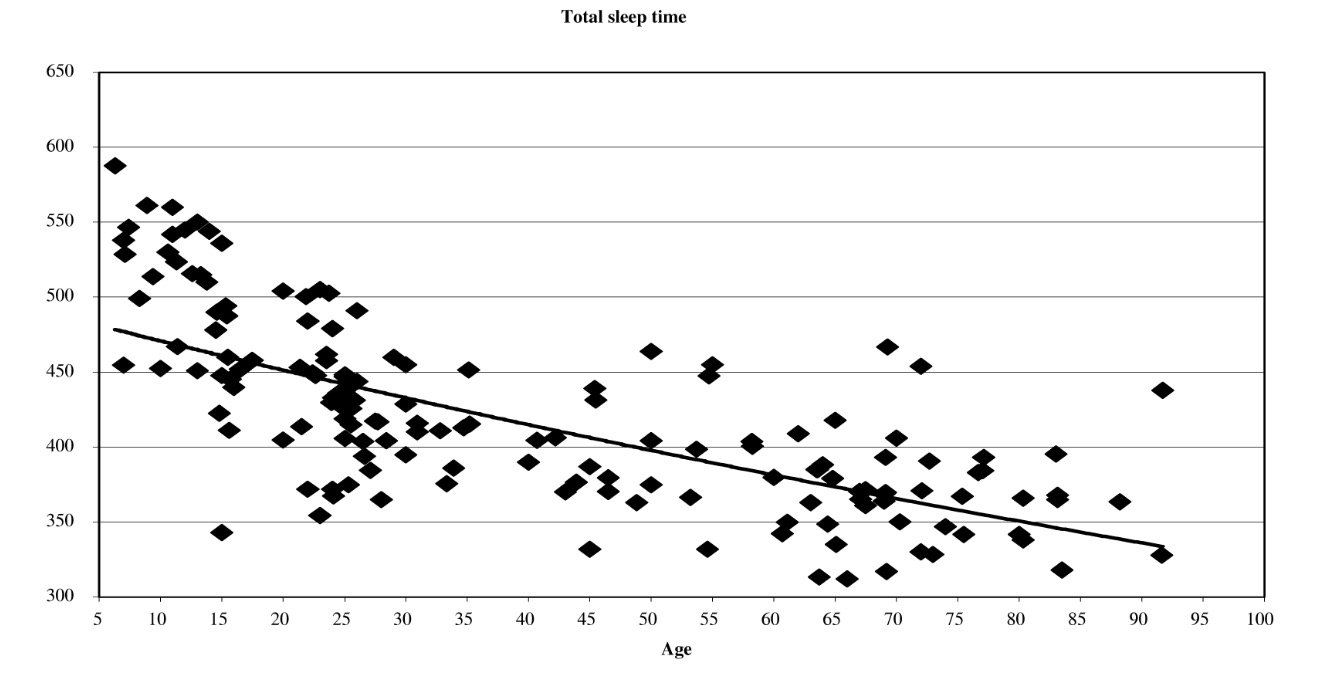
Total Sleep Time shows a clear, steep downward slope, visually confirming that we sleep less as we age.
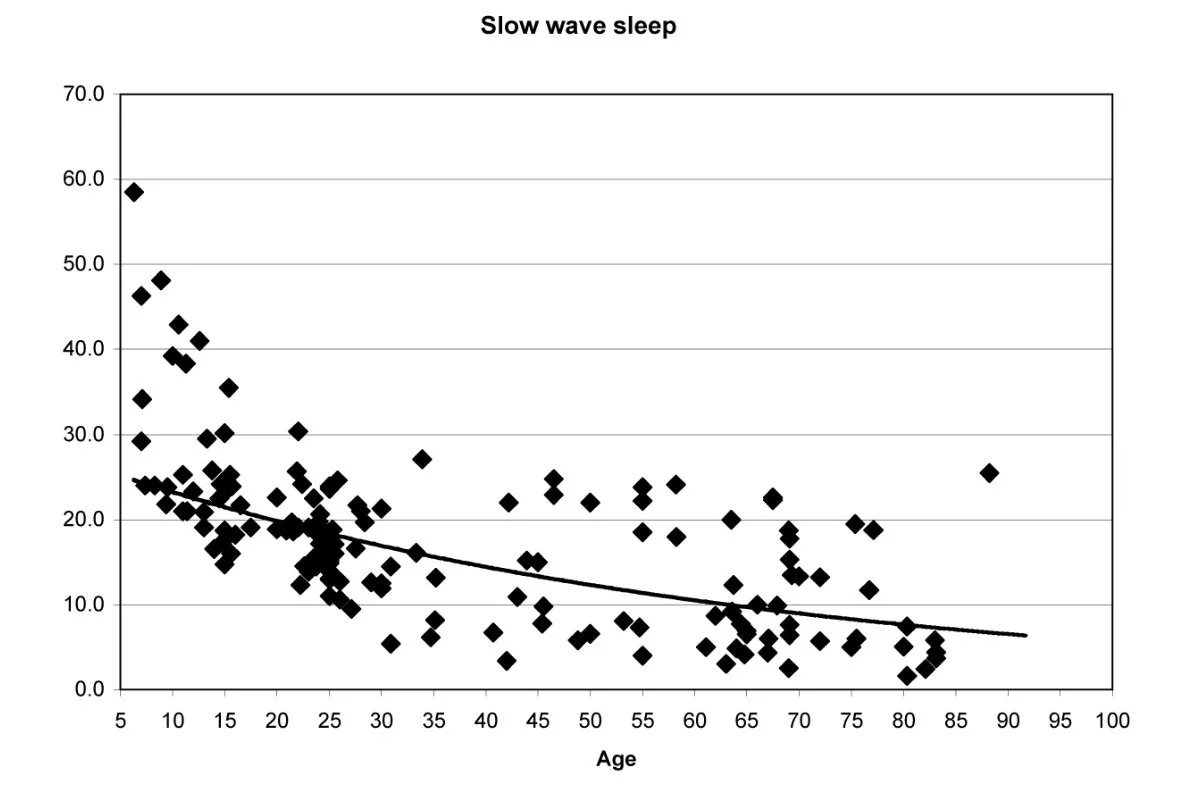
Deep Sleep (SWS) shows the most dramatic change, with a steep, consistent downward trend from childhood into old age. This visually represents the significant loss of our most physically restorative sleep stage.
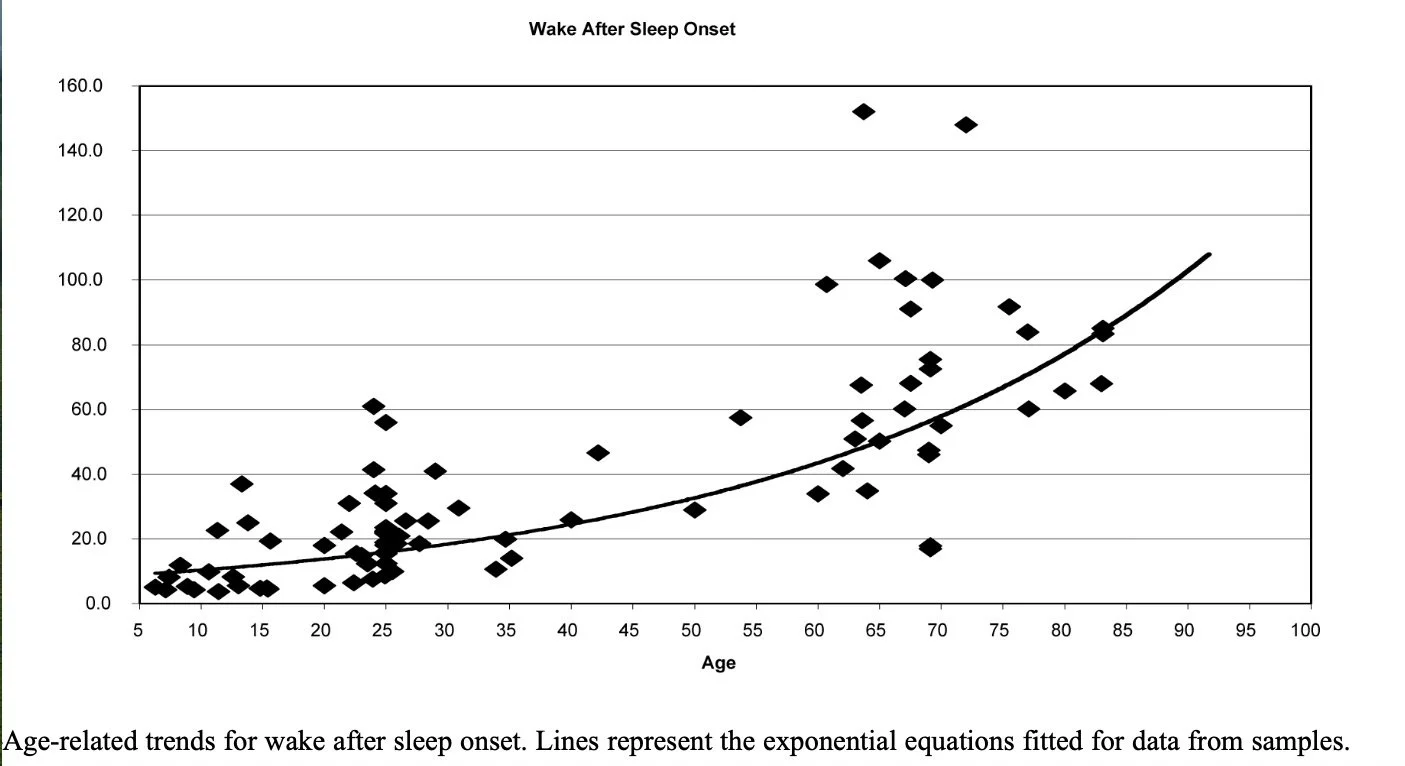
Wake After Sleep Onset (WASO) is the mirror image of this decline. The graph shows a strong, clear upward trend, providing powerful evidence that spending more time awake during the night is a normal, predictable part of aging.
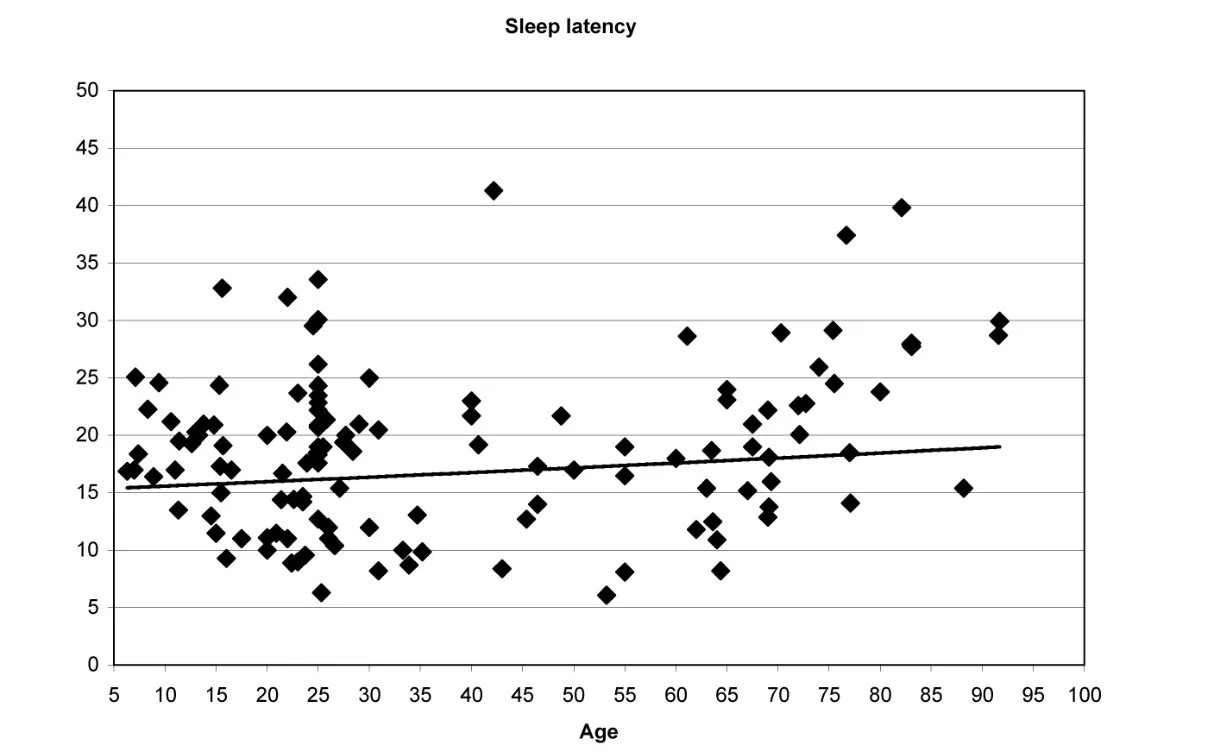
Time to Fall Asleep, in contrast, has a trend line that is almost flat. This tells us that while it does take a little longer to fall asleep as we age, the change is very small and not as dramatic as many people perceive it to be.
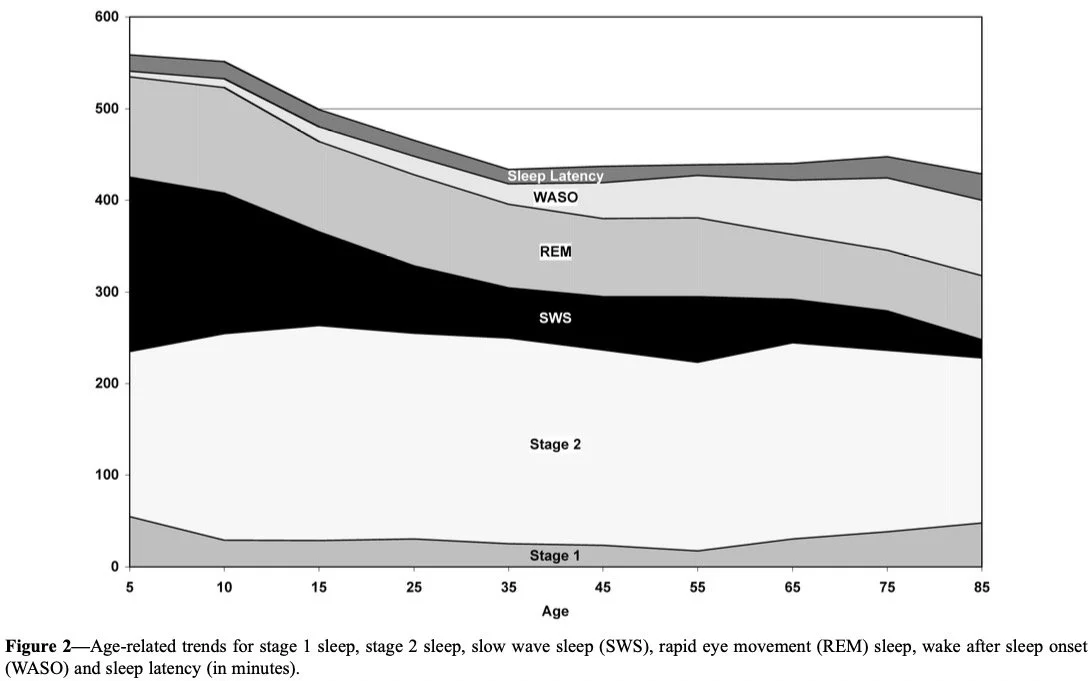
The researchers combined all this into a final summary graph showing how a night of sleep is "re-proportioned" with age. In essence, it shows the fundamental trade-off that occurs in the brain: we trade deep, restorative sleep for lighter sleep and more time spent awake during the night.
Beyond the 8-Hour Myth: What Should You Aim For Instead?
The "eight-hour rule" is one of the most persistent pieces of health advice, but it was never meant to be a strict prescription for every person at every age. The data clearly shows that our sleep needs and patterns evolve. Fixating on a single number can create anxiety that makes sleep worse. Trying to get eight hours of sleep when your body is incapable of achieving this will lead to frustration and, quite possibly, worse sleep.
Instead of aiming for a number on a clock, a healthier approach is to focus on the quality of your sleep and how you feel during the day. Here are a few key ideas to help you shift your perspective:
1. Focus on Quality and Efficiency, Not Just Quantity
The ultimate goal of sleep is restoration. A shorter, uninterrupted, high-quality night of sleep is far more beneficial than a longer, fragmented, and stressful one. As the data shows, a healthy 25-year-old might get 7.5 hours with 92% efficiency, while a healthy 65-year-old gets 6.5 hours with 83% efficiency. Both are "normal" for their age. The real question is whether that sleep is doing its job.
2. Your True Sleep Need is Individual
Just as we all have different heights and shoe sizes, we all have slightly different sleep needs, largely determined by genetics. While most adults fall within a 6.5-to-8.5-hour range, some people are natural "short sleepers" who feel great on 6 hours, while others are "long sleepers" who need 9 or more to function optimally. The eight-hour rule is a population average, not a personal mandate.
3. Waking Up During the Night is a Normal Feature of Sleep
The idea of sleeping in one solid, uninterrupted block is largely a modern myth. As the data in the tables clearly shows, waking up during the night is a normal part of sleep architecture, especially as we age. A healthy 65-year-old spending over an hour awake throughout the night is not a sign of a disorder; it's a sign of a normal 65-year-old brain. The problem isn't waking up; the problem is when you can't fall back asleep due to anxiety or other factors.
4. The Real Goal: How Do You Feel During the Day?
This is the single most important measure of whether you are getting enough sleep. Instead of asking "Did I get eight hours?" ask yourself these questions:
Do I have stable energy to get through the day without relying on excessive caffeine?
Is my mood generally stable?
Can I concentrate on tasks without feeling foggy or forgetful?
Do I feel drowsy during sedentary activities, like watching TV or sitting in a meeting?
If you feel rested and functional during the day, you are getting enough sleep for you, even if it's "only" six or seven hours. Conversely, if you are getting eight hours but still feel exhausted, it's a clear sign that thequalityof your sleep is compromised.
When Should You Be Concerned About Your Sleep?
While the changes shown in these tables are normal, it is critical to know that they do not tell the whole story. The researchers found that these "normal" patterns were only clear when they looked at exceptionally healthy individuals. When they included people with underlying medical conditions, mental health issues, or undiagnosed sleep disorders like sleep apnea, the sleep problems were much more severe (Ohayon et al., 2004).
This is the most important takeaway. While it is normal for your sleep to be lighter and more broken as you age, it is not normal for poor sleep to leave you exhausted, irritable, and unable to function during the day. Debilitating sleep problems are not a mandatory part of aging; they are often a sign of a treatable, underlying condition.
Where To From Here?
Seeing the data on how sleep normally changes with age can be incredibly validating. It helps you form realistic expectations and recognize that your experience is part of a shared, well-documented biological process. Waking up at 3 a.m. is not a personal failure; it is a normal feature of an aging brain.
However, this knowledge should also empower you to recognize when your sleep falls outside these norms. If your nights are significantly more disrupted than what you see in these tables, or if the quality of your sleep is severely impacting the quality of your waking life, it is important not to dismiss it as "just my age."
This is where a Behavioral Sleep Medicine specialist can help. They are trained to distinguish between normal, age-related changes and sleep problems driven by other factors. They can provide a structured, individualized program that goes beyond generic advice to target the specific mechanisms disrupting your sleep. The goal is not to make you sleep like a 20-year-old again, but to help you achieve the best, most restorative sleep possible for the age you are today.
Frequently Asked Questions About 8 Hours Of Sleep And Actual Normal Sleep As You Age
Q1: Is it normal to sleep less as I get older?
A1: Yes, it is completely normal to get less sleep as you get older. The research shows that healthy adults lose, on average, about 10 minutes of total sleep per night for every decade of life (Ohayon et al., 2004). For example, a healthy 25-year-old might average around 7 hours and 20 minutes of sleep, while a healthy 65-year-old typically gets closer to 6 hours and 35 minutes.
Q2: Why do I wake up so much more at night now that I'm older?
A2: Waking up more frequently is a normal and predictable part of the aging process. A large-scale analysis found that the total time spent awake during the night (after first falling asleep) increases by about 10 minutes per decade after age 30 (Ohayon et al., 2004). This means it is typical for a healthy person over 65 to spend over an hour awake throughout the night. This happens because sleep becomes lighter and more fragmented as we age.
Q3: Do I really need 8 hours of sleep every night?
A3: No, the eight-hour rule is a population average, not a strict prescription for every person at every age. The data shows that average sleep time naturally decreases below eight hours as we get older (Ohayon et al., 2004). In fact, large population studies suggest a healthy 25-year-old might average around 7 hours and 20 minutes of sleep, while a healthy 65-year-old typically gets closer to 6 hours and 35 minutes. A better measure of whether you're getting enough sleep is how you feel during the day. If you have stable energy and can concentrate without feeling drowsy, you are likely getting enough sleep for your individual needs, even if it isn't eight hours.
Q4: What happens to my deep sleep as I age?
A4: The amount of deep, restorative sleep you get declines dramatically as you age. This is one of the most significant changes researchers found, with a healthy 65-year-old getting only about half the deep sleep of a 25-year-old (Ohayon et al., 2004). This reduction in deep sleep is a primary reason why sleep can feel less refreshing in the morning as you get older.
Q5: Do teenagers really need less sleep than children?
A5: No, this is a common myth. The research clearly shows that teenagers' biological need for sleep does not decrease. They only sleep less on school nights because of early start times, not because their brains need less sleep (Ohayon et al., 2004). On weekends or during vacations, their total sleep time is similar to that of younger children.
Q6: How can I tell if my sleep problems are just normal aging or something more serious?
A6: The best way to tell is by evaluating how you feel and function during the day. While it's normal for sleep to be shorter and more broken with age, it is not normal for poor sleep to leave you exhausted, irritable, and unable to function. Debilitating daytime fatigue is often a sign that your sleep problems go beyond normal aging and may be caused by an underlying condition like sleep apnea (Ohayon et al., 2004).
References
Ohayon, M. M., Carskadon, M. A., Guilleminault, C., & Vitiello, M. V. (2004). Meta-analysis of quantitative sleep parameters from childhood to old age in healthy individuals: developing normative sleep values across the human lifespan. SLEEP, 27(7), 1255–1273.
Written By The Better Sleep Clinic
Reviewed By Dan Ford, Sleep Psychologist