


Sleep Science Briefs:
Sleep Research Updates & Clinical Insights
Navigating the Noise in Sleep Science
There is a lot of conflicting advice out there about sleep. One day a headline says a new supplement is a miracle cure; the next day, it's a health risk.
To help you navigate this, The Better Sleep Clinic team reviews the latest sleep research and news, translating complex data into actionable clinical insights. To save you time and anxiety, every update is graded using a simple Traffic Light system:
🟢 GREEN (Action: SAFE/GO): Validated science or safe, evidence-based habits.
🟡 YELLOW (Action: CAUTION/NUANCE): Nuanced findings. The study is interesting, but there are risks, limitations, or "catches" you should be aware of before acting.
🔴 RED (Action: STOP/MYTH): Debunking myths, harmful viral trends, or misleading clickbait.
🔵 BLUE (INSIGHT/FYI): Interesting sleep science with no immediate action required.
🔵 FYI: Did you know your skin has its own body clock - and bad sleep throws it off?
12/10/26
Turns out poor sleep doesn't just leave you tired. It may be affecting your skin too.
New research shows skin cells follow their own daily rhythm, tied closely to sleep and light exposure.
When sleep is disrupted - through insomnia, jet lag, or shift work - it can affect skin barrier function and inflammation, potentially playing a role in conditions like eczema and psoriasis, and even skin ageing.
Bottom line:
Good sleep isn't just about energy and mood - it may be part of keeping your skin healthy too.
Read the full study 👇
https://read.thebettersleepclinic.com/30417b562610-skin
🟡 CAUTION/NUANCE: Is your parent's sleeping tablet doing more harm than good?
12/10/26
New research on insomnia in older adults looking at 22 studies found one option that works without the risk, and one that comes with a catch.
The catch:
- benzodiazepines and Z-drugs (like zopiclone) were linked to roughly 47% higher fall risk, plus concerns about memory and thinking.
- CBT-I, a structured programme that retrains sleep habits, improved sleep efficiency (time in bed actually asleep) and cut time awake in the night by about 23 minutes. Exercise and music therapy also showed benefit.
- if medication is need, DORAs, a new class of sleeping pills, had the best efficacy-safety balance, though the effect on sleep onset was modest
Results varied between studies, so it won't look the same for everyone.
Never stop a sleeping tablet suddenly.
Talk with the prescriber about a gradual plan and ask about CBT-I.
Read the full study 👇
https://read.thebettersleepclinic.com/18d10f39-older
🟡 CAUTION/NUANCE: Is more sleep always better? Not quite.
12/10/26
A 30-year study found a surprising catch about sleeping 9+ hours.
- People who reported sleeping 9 hours or more had a higher risk of dying from any cause (about 17% higher).
- Those sleeping 6 hours or less showed no significant difference.
- This is an association study, it doesn't prove anything.
- Sleep was also only asked about once.
Long sleep can be a sign of something else going on, like high blood pressure, depression or sleep apnoea, rather than the cause itself.
Bottom line:
- If you regularly need 9+ hours and still feel flat, get it checked rather than spending more time in bed.
- If you don't sleep "8 hours" and you feel fine - don't stress.
Read the full study 👇
https://read.thebettersleepclinic.com/2a9c452c-long-sleep
🟡 CAUTION: Living with chronic pain and bad sleep? Not all "sleep fixes" are equal
22/09/26
A major new review compared medications used for sleep problems in people with ongoing pain - looking at 98 studies and almost 29,000 people.
The standout:
- melatonin improved sleep without extra safety risks.
- other options, including stronger painkillers and nerve medications, also helped sleep, but came with more side effects and weaker evidence.
Bottom line:
- If pain is wrecking your sleep, ask your GP or sleep clinician about melatonin and non-drug options like CBT-I before reaching for something stronger.
The side effects may not be worth the benefit
Read the full study 👇
https://read.thebettersleepclinic.com/a253d341-painmeds
🟡 CAUTION: Is your teen's weekend sleep-in linked to their anxiety?
20/09/26
A huge new review (235,000+ teens) found a real, if small, link between "social jetlag" (big shifts between school-night and weekend sleep) and anxiety symptoms.
The nuance:
- It's a small association, and it doesn't prove one causes the other
- Teens naturally want to sleep later than some school start times allow, which drives this shift
- American Academy of Pediatrics recommends school starts times no earlier than 8:30am
Bottom line:
- Keeping your teen's sleep-wake timing more consistent across the week, weekends included, is a low-risk habit worth encouraging alongside anything else you're doing for their anxiety.
Read the full study 👇
https://read.thebettersleepclinic.com/3a327dc1-teenanxsj
🟡 CAUTION/NUANCE: Can a nap or a quick workout save your memory after a bad night?
12/09/26
New research says yes, sort of.
But there's a catch.
A McGill University study had 54 adults stay awake for 30 hours straight. Those who did a 20-minute moderate-to-vigorous workout, or took a 90-minute nap, performed about 22% better on memory tests three days later, compared to those who did neither.
Here's the nuance:
- Naps and workouts work differently.
- Napping appears to recharge the brain, helping it absorb new information.
- Exercise doesn't recharge you, it seems to help your brain use its remaining resources more efficiently, without you feeling more tired.
- Neither replaces sleep. Think of them as damage control, not a strategy.
If you're routinely stacking sleepless nights and leaning on naps or gym sessions to cope, that's a sign your sleep needs attention.
Bottom line:
A nap or short exercise session can help you function after an occasional rough night.
A consistent, good-quality sleep is still what protects your health long term.
Read the full study 👇
https://read.thebettersleepclinic.com/d47f96a9-exercisenaps
🟡 CAUTION/NUANCE: Is there a "magic number" for sleep and ageing?
05/09/26
A massive new study of half a million people found your organs age faster if you sleep too little... or too much.
New research in Nature used biological "aging clocks" across 17 organ systems to find the sweet spot: 6.4 to 7.8 hours a night was linked to slower aging across nearly every organ, from the heart to the brain.
Clinical Comment:
This isn't about chasing a perfect number on your tracker. And it's a correlation, not proof that one extra hour causes damage.
But it does confirm what we see clinically - consistency and adequacy matter more than chasing "more is better."
Both short sleep and oversleeping were tied to issues like depression, diabetes, and heart disease, though likely via different pathways.
Bottom Line:
Aim for a steady 6.5 - 7.5ish hours rather than obsessing over maximising sleep time.
Read the full study 👇
https://read.thebettersleepclinic.com/9f7d660b-sweetspot
🟡 CAUTION/NUANCE: What's really keeping you awake at night?
A new US report combining survey data with 190 million nights of smart bed data found racing minds top the list of sleep disruptors.
But here's the catch... the report comes from a mattress brand, so naturally, physical comfort (their product) gets a lot of airtime.
But look closely at the actual findings:
- a racing mind is the number one issue. That's not a mattress problem. That's a nervous system problem (known as "hyper-arousal" in the lingo).
- so you can have the most supportive bed in the country and still lie there at 2am running through your to-do list.
The good news?
Racing thoughts at bedtime are one of the most common complaints we see in clinic, and they respond well to CBT-i, the recommended insomnia treatment (not new foam layers).
Comfort, noise, and temperature can matter, don't get us wrong. But if your brain "won't switch off", that's a behavioural sleep medicine issue, not an expensive new bed one (sorry bed retailers).
Bottom Line:
- A better mattress might help you feel comfortable, but it won't quieten a racing mind. That takes technique, not a technology upgrade.
Read the full study 👇
https://read.thebettersleepclinic.com/032dd9cc-bed
🟡 CAUTION/NUANCE: Could insomnia raise your risk of haemorrhoids?
29/08/26
A new study links insomnia with a 23.3% higher risk.
But this is not the whole story.
- Researchers also found associations with prolonged sleep and daytime napping.
- Using genetic analysis (Mendelian randomisation), the study suggests sleep disruption may contribute to haemorrhoidal disease through altered gut function, inflammation and reduced activity.
However, the research relied mainly on European-ancestry data and does not mean insomnia directly causes haemorrhoids in every person.
Bottom line (pun not intended):
- Treating insomnia with evidence-based CBT-I may support wider health, including bowel health.
Read the full study 👇
https://read.thebettersleepclinic.com/73ed4f8a-bowel
🟡 CAUTION/NUANCE: Your RLS Treatment Might Need an Update
17/08/26
If you've been on dopamine agonists for restless legs for years, your doctor may soon suggest a change. Here's why.
After two decades of prescribing dopamine agonists as the go-to first-line treatment, the Restless Legs Syndrome Foundation has released a major update supporting the AASM's 2025 guideline:
The reason?
- Augmentation: a paradoxical worsening of symptoms. Occurs in 42% to 70% of patients over 8-10 years on these drugs.
- The new algorithm shifts first-line treatment to gabapentinoids and iron therapy, reserving dopamine agonists only for cases where these fail.
- It also expands IV iron eligibility to ferritin levels up to 300 µg/L (previously 100), and elevates low-dose opioids as a serious second-line option.
What this means for you:
If you're on a dopamine agonist long-term, don't stop it abruptly. Book a review with your sleep specialist or GP to discuss whether your current treatment still fits your needs. This isn't about panic. It's about making an informed choice with your doctor based on the latest evidence.
The algorithm also details how to spot augmentation (symptoms appearing earlier, spreading, shorter relief) and how to safely transition to better options.
Bottom line:
RLS treatment has evolved. Your plan should too.
Read the full article 👇
https://read.thebettersleepclinic.com/7d8e149c-rls-update
🟡 CAUTION/NUANCE: That melatonin you ordered online from the US? It might contain 5 times the dose on the label. Or none at all.
09/08/26
Testing of US products found some products ranged from -83% to +478% of their stated melatonin content.
Here's the problem:
- In the US, melatonin is sold as an unregulated dietary supplement. No quality control. No standardised testing.
- Some products labelled as melatonin contained CBD instead. Others varied by 465% within the same batch.
- In NZ, melatonin requires a prescription for good reason - but many people still buy unverified products from overseas.
⚠️ The risks are real:
- Overseas, children have been hospitalised from accidental overdoses, particularly with gummies that look like lollies.
- If you're considering melatonin, talk to your GP or a sleep specialist first.
A qualified healthcare professional can assess whether it's appropriate and address the underlying sleep issue - because a pill rarely fixes poor sleep habits.
The bottom line:
Unregulated supplements are a gamble with your sleep and safety.
Read the full study 👇
https://read.thebettersleepclinic.com/5883a211-melcontent
🔴 STOP/MYTH: Vaping isn't the "safer" option - and it's certainly not a brain booster.
02/08/26
The marketing suggests cognitive benefits. The science tells a different story.
Here's what we know:
- Nicotine's attention effects are modest at best, and usually just mask withdrawal symptoms, not genuine improvement. Meanwhile, the real harm is clear.
- For young people, nicotine exposure during adolescence can permanently damage brain development, affecting learning, impulse control, and memory.
- Add in the cardiovascular risks, disrupted heart rhythm, inflammation, increased stroke and heart attack risk, and the picture gets darker.
And here's the sleep angle:
- nicotine is a stimulant that fragments sleep architecture, reduces deep sleep, and worsens insomnia. Poor sleep during adolescence? That compounds the developmental harm.
The bottom line:
No tobacco or nicotine product is safe, and flavoured products are deliberately targeting youth.
If you or someone you know is struggling to quit, evidence-based support (not another nicotine product) is the way forward.
Read the full statement from the American Heart Assoc 👇
https://read.thebettersleepclinic.com/4120b760-nicotineya
🔴 STOP/MYTH: "Don't exercise before bed or you'll never sleep”
15/07/26
We've all heard it. Turns out, it's not true.
New research shows exercising within 3 hours of bedtime can actually reduce how long you're awake during the night - and improve light sleep stages.
The old "no exercise after 6pm" rule? Based on assumption, not evidence.
Here's what matters more:
- Duration: Longer sessions improved total sleep time and deep sleep
- Type: Cycling beat running for slow wave sleep benefits
- Consistency: Sticking to a regular programme trumps everything
⚠️ The catch? This applies to most people
- but if late exercise genuinely wires you up, trust your body. Sleep science isn't one-size-fits-all.
The bottom line:
A 7pm workout won't wreck your sleep, but skipping exercise altogether might.
Read the full study 👉 https://read.thebettersleepclinic.com/18b524af-exerciselate
🔴 STOP/MYTH: Teen sleep problems are NOT just a phase
22/06/26
New research shows what happens at 15 can land your child in hospital at 22.
A large longitudinal study tracked adolescents from age 15 to 22 and found some sobering results:
- Teens with social jet lag (sleeping in on weekends) had nearly 2.5x higher odds of an overnight hospital stay seven years later.
- Irregular sleep onset timing doubled hospitalisation risk.
- Difficulty falling asleep twice a week or more raised hospitalisation odds by 66%.
This isn't about tired teenagers. It's about a health trajectory being set during adolescence.
The bottom line:
Poor teen sleep is a clinical signal worth acting on now, not later.
Read the full study 👉 https://read.thebettersleepclinic.com/99459884-teensleepwellbeing
🟢 SAFE/GO: If you're pregnant and struggling to sleep, there's a proven, drug-free stepped care option.
22/06/26
New research confirms what sleep specialists have long recommended - and it's not a pill.
Up to 40% of pregnant women experience insomnia, with rates climbing in the third trimester. A major new clinical algorithm, drawing on 19 international guidelines and consensus statements, places CBT-I firmly at the top of the treatment ladder - ahead of any medication.
The stepped approach:
- Start with lifestyle changes (sleep posture, limiting fluids after 5pm, light exercise/movement)
- Progress to CBT-I if insomnia persists
- Reserve medication only for severe, persistent cases under close supervision
This matters because many sleep aids carry real risks during pregnancy. CBT-I doesn't.
Bottom line:
If gestational insomnia is affecting you, ask your midwife or GP about CBT-I before reaching for anything else.
Read the full study 👉 https://read.thebettersleepclinic.com/25630cf2-pregnancy-insomnia
🔴 STOP/MYTH: If you feel “fine” after taking low-dose quetiapine, your reaction time and driving are fine too
14/06/26
A world-first clinical trial just found that a commonly prescribed off-label sleep drug impairs your driving - even when you feel fine.
Here is what the research actually shows.
- Low-dose quetiapine (an antipsychotic prescribed off-label for insomnia) modestly improved sleep quality for those with insomnia and obstructive sleep apnea.
- But the morning after, participants had slower reaction times, more attention lapses, and worse steering control in a simulated driving test.
The most concerning part?
- Some people felt okay but performed significantly worse. That gap between how you feel and how you actually function is a serious safety risk.
- Over 75% of participants reported side effects after a single dose
- The study reports around 90% of Australians with insomnia symptoms receive a sleeping pill rather than a proper sleep assessment
The bottom line:
- Feeling rested and being safe to drive are not the same thing.
- CBT-I remains the gold-standard, evidence-based treatment for insomnia (no medication required - but we do supported medication tapers)
Read the full study 👉 https://read.thebettersleepclinic.com/fef58ddf-quetiapine
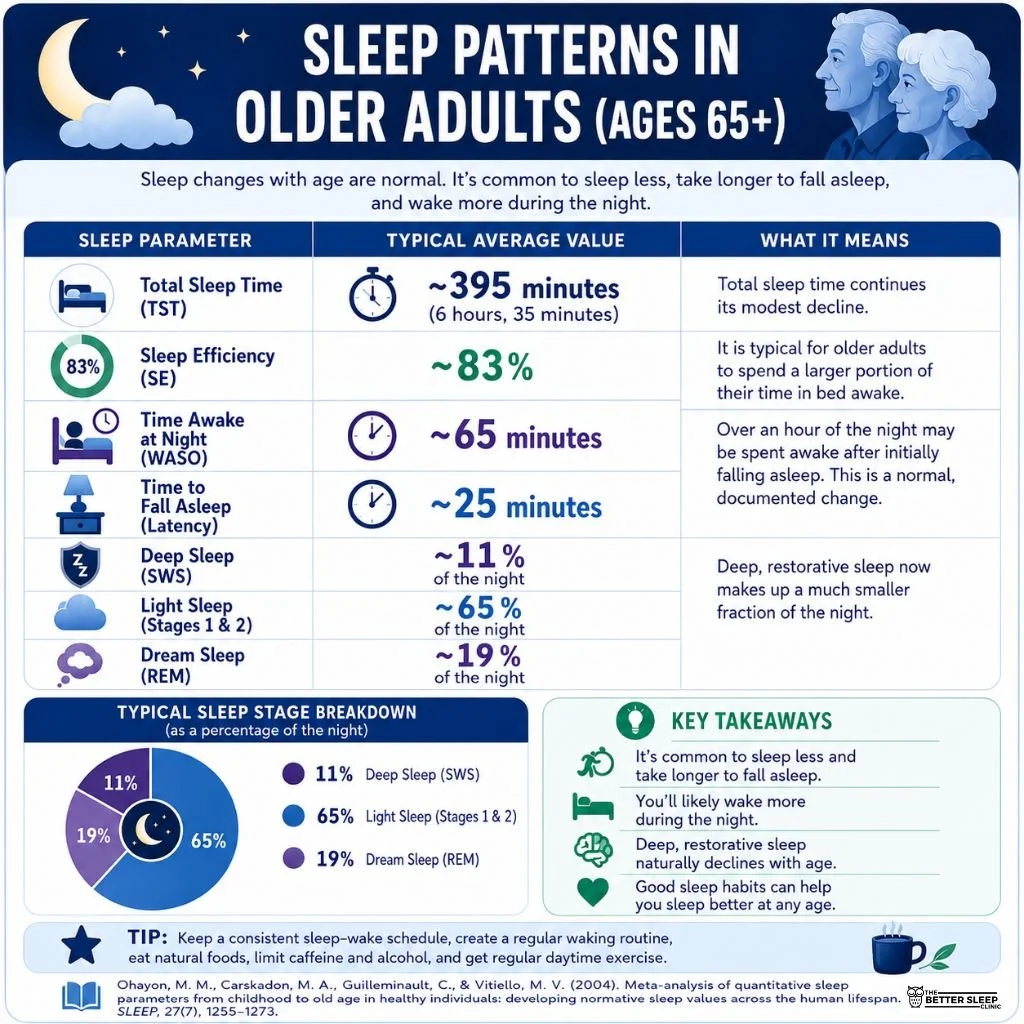
🔵 INSIGHT/FYI: Typical Sleep In Older Adults 65+
13/06/26
Sleep changes with age. But poor sleep is not something you simply have to accept.
In adults aged 65+, it is common to sleep a little less, take longer to fall asleep, and spend more time awake during the night. Deep sleep also tends to make up a smaller proportion of the night.
But “normal age-related change” is not the same as “nothing can be done.”
Good sleep habits, a consistent sleep–wake rhythm, daytime light, regular activity, and evidence-based treatment for insomnia can all help improve sleep quality at any age.
If sleep is leaving you exhausted, frustrated, or worried, it may be worth getting proper support. Better sleep is still possible - even later in life.
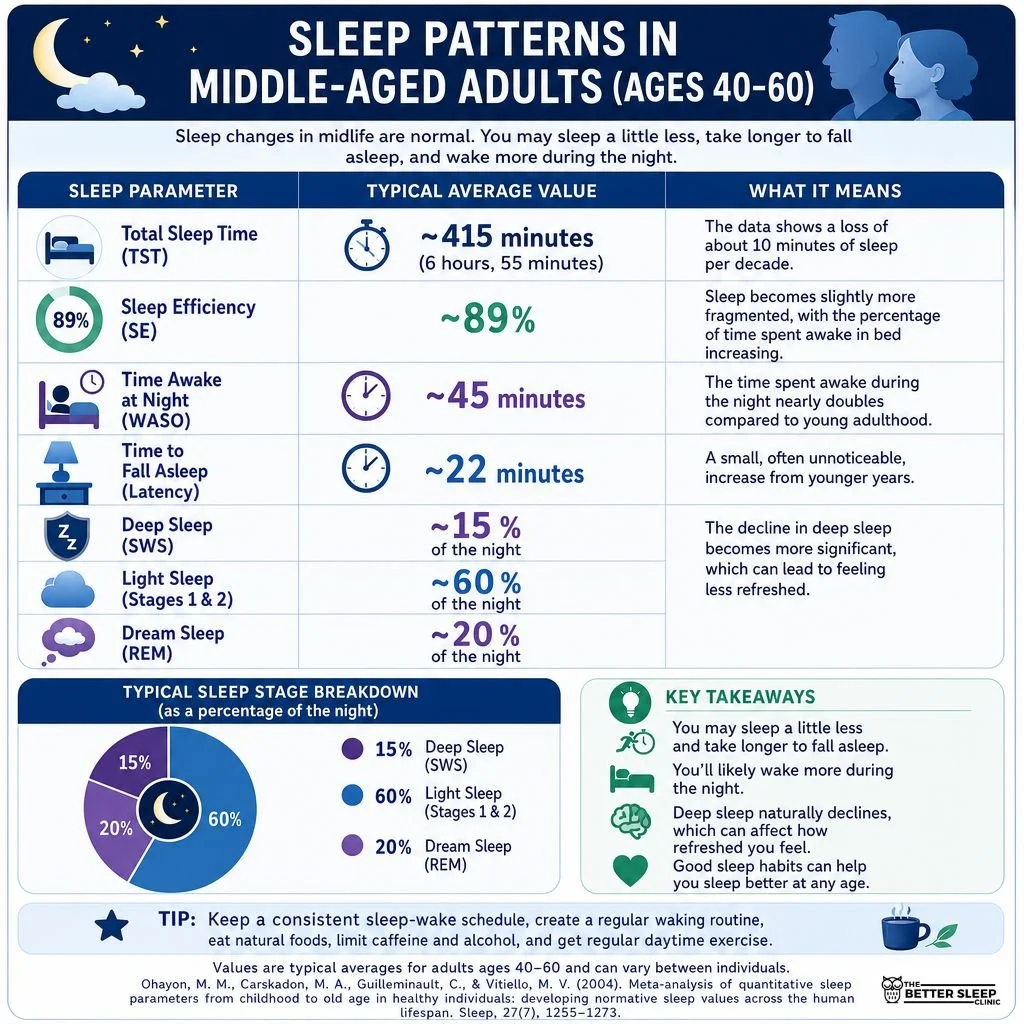
🔵 INSIGHT/FYI: Normal Sleep Changes In Midlife
08/06/26
Just like other physical abilities change with age, it's normal for your "sleep ability" to change across your lifespan.
More awakenings, longer time to fall asleep, and less deep sleep can all be part of normal midlife sleep.
Knowing what’s typical can help you recognize normal changes, reduce unnecessary concern, and seek support when sleep problems are affecting your well-being.
🟡 CAUTION/NUANCE: Midlife sleep struggles may quietly erode women's mental health for years
05/06/26
The damage doesn't stop when the sleepless nights do.
A nine-year study of 574 adults found that sleep problems in midlife predicted significantly lower psychological well-being nearly a decade later - and the effect was notably stronger in women than in men.
This wasn't just poor sleep causing a bad week. Researchers accounted for age, illness, relationship status, and other lifestyle factors, and the pattern held.
Why women?
We don't have a clear answer yet. But hormonal shifts, caregiving pressures, and how women tend to internalise stress likely all play a role.
The bottom line:
If you're a woman in midlife losing sleep regularly, this is worth taking seriously now - not later.
Scientific studies show CBT-I is the most effective insomnia treatment. Talk to a behavioural sleep medicine clinician for evidence-based support that addresses the root cause, not just the symptom.
Read the full study 👇
https://read.thebettersleepclinic.com/06109565-midlife-sleep
🟡 CAUTION/NUANCE: Pregnancy restless legs is linked to iron deficiency (but don't self-prescribe)
31/05/26
Restless Legs Syndrome (RLS) during pregnancy isn't just "normal discomfort" - and the fix isn't always more sleep.
New evidence shows pregnant women with RLS have significantly lower serum iron levels than unaffected women.
Iron deficiency disrupts the brain pathways that control movement, triggering those unbearable sensations in your legs at night.
But here's the catch:
- Not all iron supplements are equal, and timing matters.
- The research recommends checking ferritin levels first - if below 30 mcg/L, oral iron (like ferrous sulfate 65mg daily) is advised.
- For severe cases unresponsive to oral iron, IV iron may be considered in the second or third trimester under medical supervision.
The bottom line:
- If you're pregnant and struggling with restless legs, ask your GP or midwife to check your iron levels before reaching for over-the-counter supplements.
This study aligns with current RLS treatment guidelines so your GP should be aware - just ensure you're checked against RLS blood iron standards as these differ from typical standards used.
Read the full study 👇
https://read.thebettersleepclinic.com/af0300a1-rls
🟡 CAUTION/NUANCE: Sleep consistency matters beyond number of hours slept
31/05/26
👉 Click here to see the full carousel
🟡 CAUTION/NUANCE: Sleeping 8+ hours isn't automatically "healthy" - and a major new study explains why.
19/05/26
Half a million people. Every major organ. One clear pattern. And it's more complicated than you think.
Published in Nature, this large-scale study used biological aging clocks across the brain, heart, lungs, and immune system.
The finding?
- A U-shaped curve - both short sleep (under 6 hours) and long sleep (over 8 hours) were linked to faster organ aging and a wider range of diseases, including heart disease, type 2 diabetes, and depression.
- The sweet spot? Roughly 6.4 to 7.8 hours (what we're always telling patients).
But here's the clinical catch:
- short and long sleepers appear to age through different biological pathways.
- That matters enormously for treatment. Sleeping longer isn't a fix for sleeping poorly.
Bottom line:
If you're regularly sleeping outside that window, it's worth understanding why - not just how long.
Read the full study 👉 https://read.thebettersleepclinic.com/99bac174-quantity-aging
🟡 CAUTION/NUANCE: New insomnia guidelines confirm what we've known - but there's a catch
03/05/26
The latest AASM guideline reaffirms CBT-I as the gold standard for chronic insomnia. But what about adding medication to the mix?
Here's what the evidence shows:
- Combining CBT-I with medication may offer modest improvements in total sleep time for some patients.
- However, the guideline advises against choosing combination therapy over CBT-I alone.
Why?
Because CBT-I treatment produces meaningful, lasting results without the added risks of medication.
The bottom line?
- If you're already on medication, adding CBT-I makes sense.
- But starting with pills when CBT-I works on its own? That's adding risk without clear benefit.
- CBT-I first, medication only when clinically necessary.
⚠️ Chronic insomnia affects 10-15% of adults.
Treatment decisions should always involve shared decision-making between you and your clinician.
Read the full guideline 👇
https://read.thebettersleepclinic.com/ed441df4-cbtimeds
🟢 SAFE/GO: Want 40mins extra productivity in your day?
25/04/26
The answer isn't another app or supplement - it's your sleep.
New research tracking university students over 12 weeks found that mental sharpness directly determines how much you accomplish.
On days when people felt mentally sharp, they gained up to 40 extra minutes of productive work.
On foggy days? They lost that time, even on simple tasks.
The difference between your best and worst days? About 80 minutes of work.
What drives mental sharpness? Three things we talk about constantly in behavioural sleep medicine:
- Getting sufficient high quality sleep, consistently
- Circadian alignment through consistent wake patterns
- Avoiding long-term burnout and overwork
- Managing mood (poor sleep feeds depressive patterns)
This is why we focus on sleep consistency over quick fixes. Your brain's daily performance depends on it.
The Bottom Line:
- Protect your sleep, and you protect your productivity.
Read the full study 👇
🟢 SAFE/GO: 150 minutes of weekly exercise significantly lowers cortisol levels - and it might be one of the best things you can do for your sleep.
25/04/26
A year-long clinical trial of 130 adults found that meeting the standard exercise recommendation - 150 minutes of moderate aerobic activity per week - led to measurable reductions in long-term cortisol levels. (walking does not typically meet "moderate exercise" definitions)
Why this matters for sleep:
- Elevated cortisol disrupts your sleep-wake cycle, making it harder to fall asleep and stay asleep.
- Many studies show higher evening and nighttime cortisol levels in people with insomnia (termed "physiological hyperarousal")
- Regular movement helps regulate this stress hormone, supporting your body's natural rhythm. -
The study also showed exercise may slow brain ageing - another win for cognitive and emotional health.
The Bottom Line:
Consistent, moderate exercise isn't just good for your heart and brain. It's a cornerstone of healthy sleep biology.
Read the full study 👇
https://read.thebettersleepclinic.com/8f3ed38f-excort
🔵 INSIGHT/FYI: How do we actually measure "good sleep"?
21/04/26
We're often asked the question. And here's what most people miss: sleep health isn't just about whether you have insomnia or sleep apnoea or slept “x hours”.
The SATED model (now Ru-SATED) gives us a better picture.
It looks at six dimensions:
- Satisfaction with your sleep,
- Alertness during the day,
- Timing (when you sleep),
- Efficiency (how well you sleep),
- Duration, and
- Regularity.
Why does this matter? Because you can have "normal" sleep test results but still feel rubbish - or vice versa.
This framework helps us see the full picture of your sleep patterns, not just tick boxes for disorders.
At Better Sleep Clinic, our clinical assessment is 90mins because we want to cover as many dimensions of sleep health to understand where your sleep is struggling and where it's working well.
Our corporate workshops also take into account that sleep health is a continuum and you'll have "good" sleepers that gain from some optimisation tips, and 'poor' sleepers that need disorders screening.
The bottom line:
Sleep health exists on a spectrum from poor to optimal, and every dimension matters.
Read more about the research 👇
https://read.thebettersleepclinic.com/db5dc367-rusated
🟡 CAUTION/NUANCE: If you have OCD, your sleep problems aren't "just stress."
16/04/26
New research shows insomnia and circadian disruptions can actually worsen OCD symptoms - particularly intrusive thoughts and emotional regulation.
A systematic review of 28 studies confirms what we see clinically: people with OCD often struggle with insomnia, delayed sleep patterns, and evening chronotypes. These aren't just side effects - they're factors that can intensify the condition itself.
The good news?
Sleep is treatable. Addressing insomnia and circadian rhythm issues through evidence-based approaches (like CBT-I and circadian strategies) may help reduce OCD symptom severity.
The bottom line:
If you're managing OCD, your sleep deserves clinical attention - not just "sleep hygiene" or coping strategies.
Treating sleep problems won't cure OCD, but it can make treatment more effective.
Read the research 👉 https://read.thebettersleepclinic.com/c9d79bb2-ocdsymp
🟡 CAUTION/NUANCE: Does cheese really cause nightmares?
14/04/26
The short answer: It's not the cheese - it's the timing.
Here's what the research actually shows:
Only 5.5% of people in a recent study believed food affected their dreams at all. The real issue
Eating high-fat, high-protein foods (like cheese) close to bedtime slows digestion and disrupts your REM sleep - the stage where vivid dreams happen.
When your sleep quality drops, you wake more often during REM, making you more likely to remember those nightmares.
The culprit isn't cheese itself. It's eating too close to lights out.
The bottom line:
Keep at least two hours between your last meal and bedtime - your digestive system (and your dream recall) will thank you.
If you must have that late-night cheese craving? Keep the portion small.
💤 Better sleep starts with better timing, not food elimination.
Read the research 👉 https://read.thebettersleepclinic.com/60f4cd85-foodtiming
🟢 SAFE/GO: Anti-CGRP migraine drugs (erenumab, fremanezumab, and galcanezumab) don't mess with your sleep
09/04/26
Good news if you're weighing up migraine treatment options.
A review of 17 studies shows these newer anti-CGRP therapies (the monoclonal antibodies and gepants) may actually improve sleep quality - without the sedative hangover or sleep disruption that older migraine preventives often cause.
Here's what matters:
- Poor sleep quality contributes to future migraines
- Unlike tricyclic antidepressants, antiseizure meds, or beta-blockers (which can leave you groggy or wired), anti-CGRP drugs don't fundamentally alter your sleep architecture.
- In trials with over 14,000 participants, insomnia rates were low and no different from placebo.
This is a win for migraine sufferers who've been stuck choosing between headache relief and decent sleep.
The bottom line:
If you're exploring migraine prevention, these therapies offer a more sleep-friendly option than many traditional treatments.
Talk to your GP or neurologist about whether anti-CGRP therapy suits your situation - especially if past migraine meds have affected your sleep.
If you think you also have insomnia (a migraine contributor) talk to us.
Read the research 👉 https://read.thebettersleepclinic.com/f11c1853-migraine
🔵 INSIGHT/FYI Why do some people sleepwalk while others don't?
07/04/26
New research points to a tiny cluster of brain cells that might hold the answer.
Disorders of arousal (sleepwalking, sleep terrors) have puzzled sleep scientists for decades. During these episodes, parts of your brain are asleep while others are awake - a "mosaic" state where you can move, talk, even leave the house, but have no awareness or memory of it.
The latest hypothesis? A small network in the brainstem called the locus coeruleus-noradrenaline system may be the missing link. When its modular activity becomes uncoordinated, different brain regions fall out of sync - creating that eerie split between consciousness and behavior.
This research is still early, but it's helping us understand why stress, sleep deprivation, and genetics all play a role in who experiences these episodes.
The bottom line: Sleepwalking isn't just "acting out dreams" - it's a specific brain state we're only beginning to understand.
Read the full research 👉 https://read.thebettersleepclinic.com/a1047a5b-doas
🔵 INSIGHT/FYI: Your dreams might be protecting your sleep quality.
31/03/26
New research suggests vivid, immersive dreams during Stage 2 sleep actually help sleep feel deeper - even as your brain becomes more active later in the night.
A study from Italian researchers tracked over 1,000 Stage 2 awakenings in healthy sleepers and found something unexpected:
- people reported the deepest-feeling sleep after immersive dreams, not just during unconscious brain states.
The catch?
- This is about how sleep feels to someone, not objective measures of sleep architecture.
- But it might explain why some patients report poor sleep despite normal sleep studies - thought-like mental activity during sleep, rather than vivid dreaming, may leave people feeling like they were never properly asleep (a common insomnia experience)
So dreams may act as "guardians of sleep," keeping you disconnected from the outside world.
The Bottom Line:
Our subjective sleep experience is shaped by more than just sleep stages and brain waves — the quality of our sleeping and dream experiences matters too.
Read the full study 👉 https://read.thebettersleepclinic.com/bfcc25cc-dreamsleepqual
🔴 STOP/MYTH: Brushing your teeth under a bright light is not causing your 3am wake-ups.
26/03/26
A recently published media piece claims that cool-toned bathroom LEDs are a primary driver of nighttime awakenings and insomnia.
Here is what the actual science says.
- The studies cited measured sustained light exposure of 6-8 continuous hours at 100-200 lux in controlled lab settings. A 2-minute bathroom visit is not a comparable stimulus.
- Melatonin suppression from brief light exposure is temporary. Secretion resumes within minutes of lights out. This mechanism does not drive middle insomnia.
- Waking at 3am (with daytime impact) is a clinical presentation - driven by psychophysiological arousal, conditioned wakefulness, and disrupted sleep homeostatsis. A light fitting is not the cause.
Standard warm-white home LEDs (2700-3000K) already meet recommended evening light thresholds (Brown et al., 2022). The problem the article describes is largely a non-issue in most homes.
Bottom line:
If you are regularly waking in the night and struggling to get back to sleep, that deserves a clinical sleep assessment - not a home lighting change.
The original article 👉 https://read.thebettersleepclinic.com/cc06d4f0-bathlightsm
🟡 CAUTION/NUANCE: Melatonin for kids isn't the harmless sleep fix parents think it is
24/03/25
Yes, it can help children with autism or ADHD fall asleep faster - but for typically developing kids? The evidence is thin, and the risks are real.
Here's what this research reports:
- Commercial melatonin products from the US often contain wildly different doses than what's on the label - some several times higher, others with unexpected compounds like serotonin
- Poison control data shows a sharp rise in accidental ingestions, especially gummy versions that look like lollies
- Long-term safety data is nearly non-existent - we don't know how it affects puberty, immune function, or development over time
Melatonin is a biologically active hormone, not a vitamin. It shouldn't replace a proper sleep assessment or behavioural strategies.
Bottom line:
As first steps, consistent bedtimes (and wake times) and wind-down routines help - and they're safer. If you need more, a pediatric behavioural sleep medicine practitioner is the go.
If melatonin is genuinely needed, use the lowest dose, short-term, and only under medical supervision.
Read the research 👉 https://read.thebettersleepclinic.com/102ecab8-melsm
🔵 INSIGHT/FYI: 53% of people say sleep is their top health priority. The same percentage fail to get it.
19/03/26
A massive global survey supports what we see in clinic every day - knowing sleep matters doesn't mean you're actually sleeping well.
The gap is real.
- Despite 84% understanding that quality sleep extends healthy lifespan, only half achieve good sleep more than four nights weekly.
The barriers?
- Work stress (58% cite heavy workloads)
- Inadequate healthcare follow-up (only 46% report their GP asking about sleep), and
- Partner disruptions (39% interrupted weekly).
Here's the concern:
- Wearable use jumped from 16% to 53% in one year, yet only 23% of those with persistent issues have seen a provider. We're tracking sleep but not treating it.
🧠 THE BOTTOM LINE:
Awareness without access to proper assessment and evidence-based treatment (like CBT-I) leaves the problem unsolved.
The survey 👉 https://read.thebettersleepclinic.com/b0e8a09a-ressurvsm
🔵 INSIGHT/FYI: Your racing mind at 2am may have a specific type - and science is getting closer to naming it.
17/03/26
Our experience tells us not all hyperarousal looks the same, and a new study of nearly 500 people is proving exactly that.
Researchers have identified seven distinct types of hyperarousal - the state of being "switched on" or "wired" that sits at the heart of insomnia, anxiety, PTSD, depression, and ADHD.
The key finding?
- Each condition shows a different pattern of hyperarousal, not just more or less of the same thing.
- A new questionnaire has been developed to map these types, and sleep labs are already using it in research.
Why does this matter?
Because better classification means more targeted treatment - including more precise applications of CBT-I and Behavioural Sleep Medicine.
Bottom line:
This is early-stage research, but it points toward a future where your treatment matches your specific arousal profile, not just your diagnosis label.
Read the full study 👉 https://read.thebettersleepclinic.com/137f8260
🟡 CAUTION/NUANCE: Pre-bedtime rules won't magically give your teen more sleep.
12/03/26
A recent NZ study using objective sleep measures (not questionnaires) found that restricting screens and activities before bed didn't increase how long teenagers slept.
But here's the nuance: Without screens, sleep quality improved, and sleep onset was earlier.
So what's going on?
Behavioural sleep medicine practitioners following the science know that late teen sleep is driven by biology (delayed circadian rhythms) and other daytime factors , not just what you do at 9pm.
Rules can help some aspects of sleep, but they can't override a brain wired to stay awake late.
The Bottom Line:
Pre-sleep routines are part of the picture (for some), not the whole solution.
Addressing circadian timing (chronotherapy - yes, we do these treatments) is more fundamental.
Read the research 👉 https://read.thebettersleepclinic.com/bf59a806-teen-devicesm
🔵 INSIGHT/FYI: A new way to understand trauma nightmares
10/03/26
Researchers are proposing that trauma-related nightmares (TRNs) aren't just "bad dreams" - they're a dynamic process your brain uses to work through trauma during sleep.
The DIA model of TRNs suggests nightmares move through three phases:
- Disruption (the initial trauma echo);
- Integration (your brain attempting to process the memory); and
- Adaptation (gradual healing).
This explains why some nightmares replay trauma exactly, while others are more symbolic.
Why this matters
It reinforces what we already know in Behavioural Sleep Medicine - treating nightmares requires more than symptom management with medications.
We need to address the underlying sleep disruption, emotional regulation, and trauma processing together.
Effective treatments for trauma nightmares? IRT | ERRT | CBT-n
The Bottom Line:
Trauma nightmares are your brain trying to heal, not just haunt you.
Read the full research 👉 https://read.thebettersleepclinic.com/44c52c70-NightmareSM
🟡 CAUTION/NUANCE: Can fixing your gut cure insomnia? The link is real - but it's not that simple.
04/03/26
A review of 41 studies shows associations between poor sleep and changes in gut bacteria, particularly in people with chronic insomnia.
But here's the catch: the research doesn't identify which comes first. Does disrupted sleep change your gut?
Or does an unhealthy gut disrupt sleep?
Likely both.
The science is still too early to recommend probiotics or gut protocols as insomnia treatments.
What we do know works: evidence-based behavioural sleep interventions (CBT-I) that address the root causes of insomnia - not just symptoms.
Our clinical experience? Addressing insomnia can help stabilise gut issues (at a minimum).
Bottom line:
Don't chase gut health trends as a sleep fix until your sleep behaviour is sorted first. Read the full study 👉 https://read.thebettersleepclinic.com/gutsm
🟢 SAFE/GO: Night shift workers - this simple diet change might protect your heart
02/03/26
New research from 220,000 UK adults shows that night shift workers who ate around 19 grams of fibre daily had a lower risk of coronary artery disease compared to those with low fibre intake.
That's less than the standard recommendation (25g), but it still showed a protective effect.
Why?
Fiber may improve gut health and reduce harmful lipid levels - both affected by shift work.
The bottom line:
If you work nights, adding more whole grains, vegetables, fruit, and legumes to your meals could support your heart health alongside good sleep hygiene practices.
The study 👉 https://read.thebettersleepclinic.com/fibre-shiftsm
🟡 CAUTION/NUANCE: Treating your sleep apnea but still can't sleep? Your heart is still at risk.
26/02/26
New research on nearly 1 million veterans shows something critical: having both insomnia AND sleep apnea creates a far worse cardiovascular threat than either condition alone.
This combination - called COMISA - isn't just two problems sitting side by side. They interact, amplify each other, and significantly increase your risk of hypertension and heart disease.
Here's what matters:
-"Treating one while ignoring the other is a bit like bailing water out of a boat without fixing the leak," says lead researcher Dr Allison Gaffey.
- Your CPAP treats the apnea. But if you're still lying awake for hours, your cardiovascular system never gets the recovery it needs overnight.
The bottom line:
- Both conditions need attention.
- Sleep apnea needs medical treatment.
- Insomnia responds best to CBT-I - the gold standard behavioural therapy that addresses the root cause.
If you're managing one but still struggling with the other, it's time to address both.
Read the full study https://read.thebettersleepclinic.com/comisasm
🟡 CAUTION/NUANCE: Menopause changes your brain - and your sleep pays the price.
24/02/26
New research on 125,000 women reveals post-menopausal women face more insomnia, fatigue, anxiety, and depression - alongside measurable brain changes.
Here's what surprised many (but not the behavioural sleep medicine community):
- HRT didn't prevent these brain, sleep or mental health shifts.
- Women on HRT actually reported the highest fatigue levels, despite sleeping the same hours as those not on HRT.
- HRT did slow reaction time decline slightly, but it's not the answer for sleep or mood struggles.
- For further research: The brain regions affected are the same ones involved in Alzheimer's - which may explain why women face nearly double the dementia risk.
THE BOTTOM LINE:
If menopause is disrupting your sleep or mood, lifestyle support and evidence-based behavioural treatment (like CBT-I) matter more than hormones alone.
Read the full study https://read.thebettersleepclinic.com/menosm
🟡 CAUTION/NUANCE: Keep your bedroom below 24°C if you're over 65
19/02/26
New research suggests this simple temperature setting can lower stress on the heart for older adults during sleep.
Here's why it matters:
When your bedroom is too warm overnight, your heart works harder to cool you down - increasing heart rate and limiting recovery from the day's heat.
For older adults, this sustained effort creates stress when your body should be resting.
Australian researchers tracked real-world sleep data using fitness trackers and bedroom sensors throughout summer.
The finding?
Above 24°C (75°F) increased cardiovascular strain during sleep in people aged 65+.
With climate change bringing more hot nights, this isn't just about comfort - it's about protecting your heart's recovery time.
The bottom line:
If you're over 65, aim for 24°C or below in your bedroom overnight, especially during warmer months.
🔵 FYI/INSIGHT: Turns out "night owl" isn't one thing.
17/02/26
New research just split sleep types into five distinct biological subtypes - and they don't all carry the same risks.
A McGill University study of 27,000+ adults found three types of night owls and two types of early birds - each with different health and behaviour patterns.
- One night owl group had sharp cognition but struggled with emotional regulation.
- Another faced higher cardiovascular risks.
- One early bird group thrived, whilst another showed links to depression.
This explains why blanket advice ("just go to bed earlier!") doesn't work for everyone. Your chronotype (aka body clock type) isn't just about bedtime - it's shaped by genetics, environment, and lifestyle.
The bottom line:
Sleep isn't one-size-fits-all, and neither is treatment (and yes, we treat circadian rhythm disorders).
Read the full study https://read.thebettersleepclinic.com/chron5fb
🔵 INSIGHT/FYI: Ever wondered why you sleep poorly in hotels?
Scientists have found the brain circuit responsible for the "first night effect" - that restless night in unfamiliar places.
Researchers identified specific neurons in the extended amygdala (brain area associated with emotions) that release neurotensin (boosts vigilance) when you're in a new environment, keeping your brain on alert.
- It's an evolutionary survival mechanism - your brain staying vigilant against potential threats.
- The study (in mice) showed this circuit involves areas present in all mammals, suggesting humans share this response.
- While the findings might one day lead to new treatments for insomnia or PTSD-related sleep issues, we're years away from clinical application.
The Bottom Line:
Your brain is doing its job when you sleep poorly somewhere new - it's biology, not a sleep problem/disorder.